Khóa học
IELTS Online
IELTS Online
Giảm đến 18%
Đăng ký ngay
Mục lục [Ẩn]
Đề thi IELTS Reading ngày 13.01.2026 gồm ba passage: A Study of Western Celebrity, How deserts are formed, Marketing and the Information Age. Bài viết dưới đây cung cấp lời giải chi tiết từng câu hỏi và nội dung cụ thể của từng bài đọc trong đề thi thật, giúp bạn nắm rõ cấu trúc đề và chủ động hơn khi luyện tập với đề thi thật.
A Study of Western Celebrity
A. It seems that our current society cannot get enough information about the daily lives of celebrities. But how did celebrities become such an important force in our culture? While people have always shared a certain obsession for the fantastic and the famous, the notion of celebrity, as well as the types of people termed ‘celebrities,’ has evolved greatly throughout the ages. The word ‘celebrity’ has its roots in the language of the ancient Roman civilization. The word we now know to mean ‘a condition of being famous’ or ‘a famous person’ is derived from the Latin word ‘celeber,’ meaning frequented or populous.
B. The celebrities of the ancient world were the powerful and awesome deities of Greece and Rome, and the citizens of these civilizations believed in a vast number of immortals who had a direct impact on their lives. It was, therefore, important to know about these figures’ personal lives. This need to know led to the creation of myths, which personalized the gods and involved them in ancient celebrity scandals that thrilled and excited the common people.
C. During ancient times, amateur and professional athletes also began to make an impact on the celebrity culture. Victors in the ancient Olympic Games were treated as heroes and were often elevated to god-like status. In the ancient Roman civilization, gladiators—the equivalent of today’s professional athletes—were also revered by the common people for their heroics and seemingly superhuman strength.
D. As Europe moved into the Dark Ages (the years spanning approximately 400-1300 AD) and a time when athletics and the arts were largely forgotten, monarchs and rulers continued to maintain celebrity status, while religious figures took on newfound fame. The miraculous lives and fascinating deaths of spiritual figures lent excitement to the lives of common people when there was often little else to be excited about, as they faced war, disease, and food shortages.
E. During the period 1300-1600 AD, or the Renaissance period as it is known, interest in ruling figures faded. As Europe emerged from its long neglect of the arts, there was greater appreciation for portraits, statues, and stone carvings. This period of appreciation for the arts lent a sense of celebrity to artists who were noted for their works and their personal achievements. It was a time when artists began to surpass political and religious individuals for supreme celebrity - a trend that would continue into later centuries.
F. While the figures of the ancient and early modern civilizations were able to achieve moderate and sometimes lasting celebrity within particular cultures, the global reach of their fame was limited. It was not until the 1700s, when technological advances made publishing commercially viable, that the extent of a person’s fame could spread further. The increase in the availability of the written word was accompanied by a huge rise in the number of common people who could read, allowing a mass audience to find out about celebrities for the first time. Suddenly, the lives of authors, politicians, war heroes, and other celebrities could now be read about in newspapers around the world. These gave ordinary people the opportunity to become intimately knowledgeable about the figures they most admired.
G. In the modern era, particularly as radio and film took off in the 1900s, things really began to change. First, radio began to make its way into the average home in the 1920s and 1930s. Professional athletes also began to be regarded as stars, as their games and exploits could be broadcast over the air for an entirely new audience. Then, the rise of television in the 1950s only cemented the premier level of celebrity that film stars, athletes, and television actors were beginning to share. This also meant a huge increase in the individual salaries of these celebrities. Even a few animals gained fame through children’s TV shows. The emergence of reality television shows in the late 1990s allowed all kinds of people with little ability to enjoy a short burst of fame on the television screen. All you needed, it seemed, was an attractive appearance. Today, reality television programmes make it possible to be famous not for doing anything in particular, but simply for being, with the audience deciding whether someone deserves to become a celebrity or not. As the meaning of celebrity continues to evolve and redefine itself in a quickly changing world, there is no telling who will become of interest next.

Questions 1 – 7
Reading Passage 2 has seven paragraphs, A–G.
Choose the correct heading for each paragraph from the list of headings below. Write the correct number, i–x, in boxes 1–7 on your answer sheet.
List of Headings
i. Why it is necessary to explain the meaning of the word celebrity
ii. The influence of non-human celebrities on societies
iii. The impact of broadcasting on concepts of celebrity
iv. Creativity having greater value
v. Admiration for physical achievement
vi. The advantages of celebrity status in the ancient world
vii. A result of hardship
viii. Literacy and widespread celebrity
ix. Attitudes of celebrities towards the media
x. The original definition of celebrity
Paragraphs
Paragraph A
Paragraph B
Paragraph C
Paragraph D
Paragraph E
Paragraph F
Paragraph G
Questions 8 – 10
Look at the following statements (Questions 8–10) and the list of historical periods in Europe below.
Match each statement with the correct historical period, A, B, C, or D. Write the correct letter, A, B, C, or D, in boxes 8–10 on your answer sheet.
List of Historical Periods in Europe
A. Ancient times
B. Dark Ages
C. Renaissance
D. Modern era
8. A wide variety of people achieve a brief period of fame.
9. Stories are invented about celebrities’ lives.
10. The fame of rulers is starting to diminish.
Questions 11 – 13
Complete the summary below.
Choose ONE WORD ONLY from the passage for each answer. Write your answers in boxes 11–13 on your answer sheet.
Celebrities Achieve a Global Status
The development of the publishing industry in the 1700s signalled the beginning of international fame. A growing number of people could read, which meant they had the chance to become informed about their favourite figures by reading 11. ______.
This exposure to celebrities expanded further when radio and television became popular, and it was mass media attention that resulted in higher status and fame for some celebrities.
The recent rise of reality television has also meant that a person’s 12. ______ rather than their talent can bring fame. With this type of television programme, fame may be entirely dependent on the response of the 13. ______.
>>> XEM THÊM:
Đề thi IELTS Reading có đáp án mới nhất 2025-2026 [Cập nhật liên tục]
Giải đề thi thật IELTS Reading ngày 04.01.2026 [Full Answers]
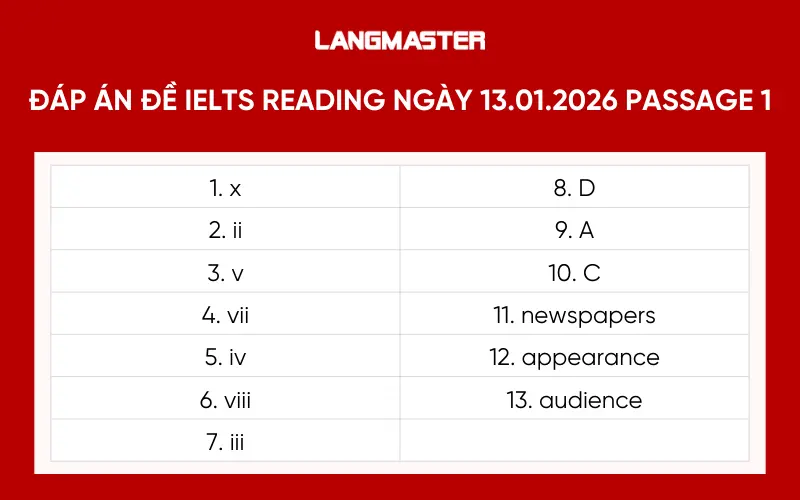
Bảng đáp án đề IELTS READING ngày 13.01.2026 PASSAGE 1
|
1. x |
8. D |
|
2. ii |
9. A |
|
3. v |
10. C |
|
4. vii |
11. newspapers |
|
5. iv |
12. appearance |
|
6. viii |
13. audience |
|
7. iii |
Questions 1 – 7: Matching Headings
1. Paragraph A – x (The original definition of celebrity)
Phân tích: Đoạn A tập trung làm rõ nguồn gốc và ý nghĩa ban đầu của từ “celebrity”. Tác giả giải thích từ này bắt nguồn từ tiếng Latin “celeber”, mang nghĩa là “nổi tiếng” hoặc “được nhiều người biết đến”.
Dấu hiệu nhận biết nằm ở phần: “derived from the Latin word ‘celeber’…”. → Vì vậy, tiêu đề phù hợp nhất là định nghĩa nguyên thủy của từ celebrity.
2. Paragraph B – ii (The influence of non-human celebrities on societies)
Phân tích: Đoạn này nói về các vị thần Hy Lạp và La Mã – những “celebrity” đầu tiên – dù họ không phải con người. Người dân quan tâm đến đời sống của các vị thần và tạo ra các câu chuyện huyền thoại xoay quanh họ.
Câu then chốt: “creation of myths, which personalized the gods…” → Phù hợp với ý nói về ảnh hưởng của những “người nổi tiếng không phải con người”.
3. Paragraph C – v (Admiration for physical achievement)
Phân tích: Nội dung xoay quanh vận động viên Olympic và đấu sĩ La Mã – những người được tôn vinh nhờ sức mạnh và thành tích thể chất.
Cụm quan trọng: “revered… for their heroics and seemingly superhuman strength.” → Đây là sự ngưỡng mộ thành tựu thể chất.
4. Paragraph D – vii (A result of hardship)
Phân tích: Thời kỳ Tăm tối đầy chiến tranh, bệnh tật và thiếu lương thực khiến con người tìm đến các nhân vật tôn giáo như một nguồn an ủi và hy vọng.
Trích: “…as they faced war, disease, and food shortages.” → Sự nổi tiếng ở giai đoạn này là kết quả của hoàn cảnh khó khăn.
5. Paragraph E – iv (Creativity having greater value)
Phân tích: Sang thời kỳ Phục hưng, nghệ thuật phát triển mạnh, và các nghệ sĩ bắt đầu vượt qua chính trị gia và nhân vật tôn giáo về mức độ nổi tiếng.
Câu quan trọng: “…artists began to surpass political and religious individuals…” → Điều này thể hiện giá trị của sáng tạo nghệ thuật được đề cao.
6. Paragraph F – viii (Literacy and widespread celebrity)
Phân tích: Vào những năm 1700, ngành xuất bản phát triển và số người biết đọc tăng mạnh, giúp sự nổi tiếng lan rộng ra phạm vi quốc tế.
Chi tiết then chốt: “huge rise in the number of common people who could read…” → Sự gia tăng khả năng đọc viết giúp celebrity trở nên phổ biến hơn.
7. Paragraph G – iii (The impact of broadcasting on concepts of celebrity)
Phân tích: Đoạn này nói về ảnh hưởng của radio, phim ảnh, truyền hình và đặc biệt là truyền hình thực tế đến khái niệm người nổi tiếng.
Chi tiết chính: “radio… television… reality television…”
→ Công nghệ truyền thông đã thay đổi hoàn toàn cách tạo ra và duy trì sự nổi tiếng.
Questions 8 – 10: Matching Feature
8. D (Modern era)
Phân tích: Ở thời hiện đại, đặc biệt là cuối những năm 1990, truyền hình thực tế cho phép rất nhiều người bình thường có được một khoảng thời gian nổi tiếng ngắn ngủi.
Cụm từ quan trọng: “a short burst of fame.”
9. A (Ancient times)
Phân tích: Trong thời cổ đại, người ta sáng tạo ra các câu chuyện huyền thoại về các vị thần để thỏa mãn sự tò mò của công chúng.
Chi tiết: “creation of myths…”
10. C (Renaissance)
Phân tích: Thời Phục hưng chứng kiến sự suy giảm mức độ quan tâm đến các nhà cầm quyền, trong khi nghệ sĩ lên ngôi.
Câu then chốt: “interest in ruling figures faded.”
Questions 11 – 13: Summary Completion
11. newspapers
Phân tích: Khi tỷ lệ biết chữ tăng lên, mọi người có thể đọc báo để tìm hiểu về các nhân vật nổi tiếng.
Cụm gốc: “read about in newspapers around the world.”
12. appearance
Phân tích: Truyền hình thực tế cho thấy chỉ cần ngoại hình hấp dẫn cũng có thể nổi tiếng, không nhất thiết phải có tài năng.
Câu gốc: “All you needed… was an attractive appearance.”
13. audience
Phân tích: Sự nổi tiếng ngày nay phụ thuộc nhiều vào quyết định của khán giả.
Chi tiết: “…with the audience deciding whether someone deserves to become a celebrity or not.”
>>> XEM THÊM:
Giải đề thi thật IELTS Reading ngày 16.01.2026 [Full Answers]
Giải đề IELTS Reading: The Impact of Invasive Species [Full answers]

How deserts are formed
A. A desert refers to a barren section of land, mainly in arid and semi-arid areas, where there is almost no precipitation, and the environment is hostile for any creature to inhabit. Deserts have been classified in a number of ways, generally combining total precipitation, how many days the rainfall occurs, temperature, humidity, and sometimes additional factors. In some places, deserts have clear boundaries marked by rivers, mountains or other landforms, while in other places, there are no clear-cut borders between deserts and other landscape features.
B. In arid areas where there is not any covering of vegetation protecting the land, sand and dust storms will frequently take place. This phenomenon often occurs along the desert margins instead of within the deserts, where there are already no finer materials left. When a steady wind starts to blow, fine particles on the open ground will begin vibrating. As the wind picks up, some of the particles are lifted into the air. When they fall onto the ground, they hit other particles which will then be jerked into the air in their turn, initiating a chain reaction.
C. There has been a tremendous deal of publicity on how severe desertification can be, but the academic circle has never agreed on the causes of desertification. A common misunderstanding is that a shortage of precipitation causes desertification—even the land in some barren areas will soon recover after the rain falls. In fact, more often than not, human activities are responsible for desertification. It might be true that the explosion in world population, especially in developing countries, is the primary cause of soil degradation and desertification. Since the population has become denser, the cultivation of crops has gone into progressively drier areas. It’s especially possible for these regions to go through periods of severe drought, which explains why crop failures are common. The raising of most crops requires the natural vegetation cover to be removed first; when crop failures occur, extensive tracts of land are devoid of a plant cover and thus susceptible to wind and water erosion. All through the 1990s, dryland areas went through a population growth of 18.5 per cent, mostly in severely impoverished developing countries.
D. Livestock farming in semi-arid areas accelerates the erosion of soil and becomes one of the reasons for advancing desertification. In such areas where the vegetation is dominated by grasses, the breeding of livestock is a major economic activity. Grasses are necessary for anchoring barren topsoil in a dryland area. When a specific field is used to graze an excessive herd, it will experience a loss in vegetation coverage, and the soil will be trampled as well as pulverised, leaving the topsoil exposed to destructive erosion elements such as winds and unexpected thunderstorms. For centuries, nomads have grazed their flocks and herds to any place where pasture can be found, and oases have offered chances for a more settled way of living. For some nomads, wherever they move to, the desert follows.
E. Trees are of great importance when it comes to maintaining topsoil and slowing down the wind speed. In many Asian countries, firewood is the chief fuel used for cooking and heating, which has caused uncontrolled clear-cutting of forests in dryland ecosystems. When too many trees are cut down, windstorms and dust storms tend to occur.
F. What’s worse, even political conflicts and wars can also contribute to desertification. To escape from the invading enemies, the refugees will move altogether into some of the most vulnerable ecosystems on the planet. They bring along their cultivation traditions, which might not be the right kind of practice for their new settlement.
G. In the 20th century, one of the states of America had a large section of farmland that had turned into desert. Since then, actions have been enforced so that such a phenomenon of desertification will not happen again. To avoid the reoccurring of desertification, people shall find other livelihoods which do not rely on traditional land uses, are not as demanding on local land and natural resource, but can still generate viable income. Such livelihoods include but are not limited to dryland aquaculture for the raising of fish, crustaceans and industrial compounds derived from microalgae, greenhouse agriculture, and activities that are related to tourism. Another way to prevent the reoccurring of desertification is to bring about economic prospects in the city centres of drylands and places outside of drylands. Changing the general economic and institutional structures that generate new chances for people to support themselves would alleviate the current pressures accompanying the desertification processes.
H. In nowadays society, new technologies are serving as a method to resolve the problems brought by desertification. Satellites have been utilised to investigate the influence that people and livestock have on our planet Earth. Nevertheless, it doesn’t mean that alternative technologies are not needed to help with the problems and process of desertification.

Questions 14-20
Reading Passage 2 has eight paragraphs, A-H.
Which paragraph contains the following information?
Write the correct letter, A-H, in boxes 14-20 on your answer sheet.
NB You may use any letter more than once.
14. a reference to the irregular movement of particles
15. mention of a productive land turning into a desert in the 20th century
16. types of deserts
17. mention of technical methods used to tackle the problems of deserts
18. the influence of migration on desertification
19. lack of agreement among the scientists about the causes of desertification
20. a description of the fatal effects of farming practice
Questions 21-26
Do the following statements agree with the information given in Reading Passage 2?
In boxes 21-26 on your answer sheet, write
TRUE if the statement is true
FALSE if the statement is false
NOT GIVEN if the information is not given in the passage
21. It is difficult to ascertain where the deserts end in some areas
22. Media is uninterested in the problems of desertification.
23. The most common cause of desertification is the lack of rainfall.
24. Farming animals in semi-arid areas will increase soil erosion.
25. People in Asian countries no longer use firewood as the chief fuel.
26. Technology studying the relationship of people, livestock and desertification has not yet been invented.
>>> XEM THÊM:
Cách làm Multiple Choice trong IELTS Reading ẵm trọn điểm tối đa
Cách làm Matching Information trong IELTS Reading “ẵm trọn” điểm cao
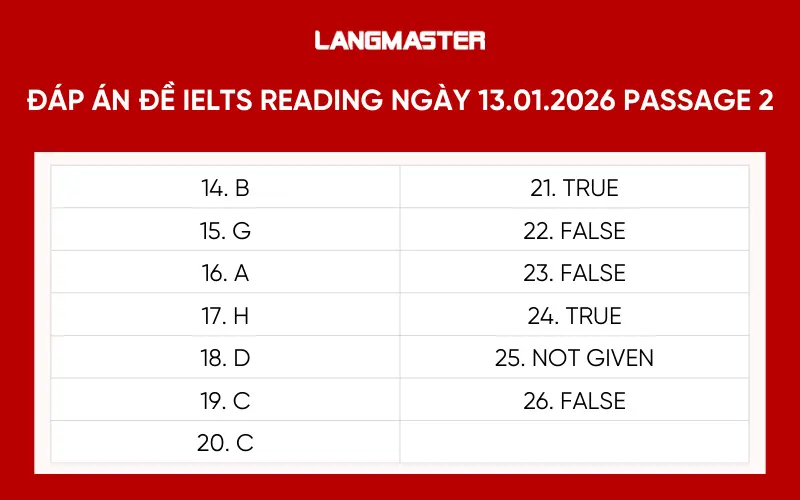
Bảng đáp án đề IELTS READING ngày 13.01.2026 PASSAGE 2
|
14. B |
21. TRUE |
|
15. G |
22. FALSE |
|
16. A |
23. FALSE |
|
17. H |
24. TRUE |
|
18. D |
25. NOT GIVEN |
|
19. C |
26. FALSE |
|
20. C |
Bạn có thể xem lời giải chi tiết tại đây: Giải đề IELTS Reading: How deserts are formed [Full answers]
>>> XEM THÊM:
Marketing and the Information Age
For the early practitioners of marketing in the late 19th and early 20th centuries, the business of selling was simply a matter of continually finding new customers. By contrast, marketing managers in the current era recognise the importance of gathering information about the market and about potential customers. They recognise that if companies are to be profitable, customers must gain and retain their perceptions of value from the brands they buy over a long time frame, rather than from a single transaction. This also means that customers must see value in returning continually to the stores where they shop, as well as to the service providers they deal with.
Marketing practitioners and marketing scientists have never worked more closely than they currently do. There are many reasons for this, including the fact that this is the information age where convergence in telecommunications, media and technology is causing old ways to be challenged, and new methods and tools to be tested. Customer expectations have risen as new technologies allow new approaches. For instance, the subscriber-TV music channel Channel [V] encourages its viewers to sign up for text messages and email alerts that tell them when their favourite artists and songs are about to be broadcast. Competitive advantage lies in being able to recognise which customers can be given greater attention, not just because they demand it but because it makes commercial sense to provide high levels of product quality and service.
Modern marketing information systems rely on information technology to enable marketing intelligence to be gathered and to store and analyse marketing research information. While some of the information used is gathered by government bodies such as the Australian Bureau of Statistics and Statistics New Zealand, most of it is purposefully gathered by marketing organisations for client companies. In the process, computer technology is used to manipulate the data and then to present the information in such a way that executives can readily identify any problems or issues, and quickly arrive at solutions.
In order to produce superior value and satisfaction for customers, marketing managers need information at almost every turn. They need information about customers-end-users and resellers as well as competitors and governmental and other forces in the marketplace. One marketing executive put it this way: "To manage a business well is to manage its future, and to manage the future is to manage information." Increasingly, marketers are viewing information not just as an input for making better decisions but also as an important strategic asset and marketing tool. As household incomes increase, choice widens and buyers become better discriminating, so sellers need information about how buyers respond to different products and advertising campaigns.
The supply of information has also increased greatly. It has been suggested by the futurist and best-selling author John Naisbitt that the United States and, by observation, developed countries such as Australia, New Zealand, and Singapore are moving from industrial to information-based economies. These post-industrial economies earn 70-80% of their Gross Domestic Product from services, and have entered what some commentators have termed the "Information Age" or the "Information Technology Era".
One study found that with all the information now available through supermarket scanners, a packaged goods product controller is bombarded with one million to one billion new numbers each week. As Naisbitt points out: "Running out of information is not a problem, but drowning in it is." Yet marketers frequently complain that they lack information of the right kind but have plenty of the wrong kind, or they claim that marketing information is so widely spread throughout the organisation that it takes great effort to locate even simple facts. In addition, subordinates may withhold information they believe will reflect badly on their performance, and important information often arrives too late to be useful, or on-time information is not accurate. So marketing managers need better information. Although marketing organisations have greater capacity to provide managers with information, they often do not use it well. As a result, many marketing organisations are now studying their managers' information needs and designing information systems specifically to meet those needs.
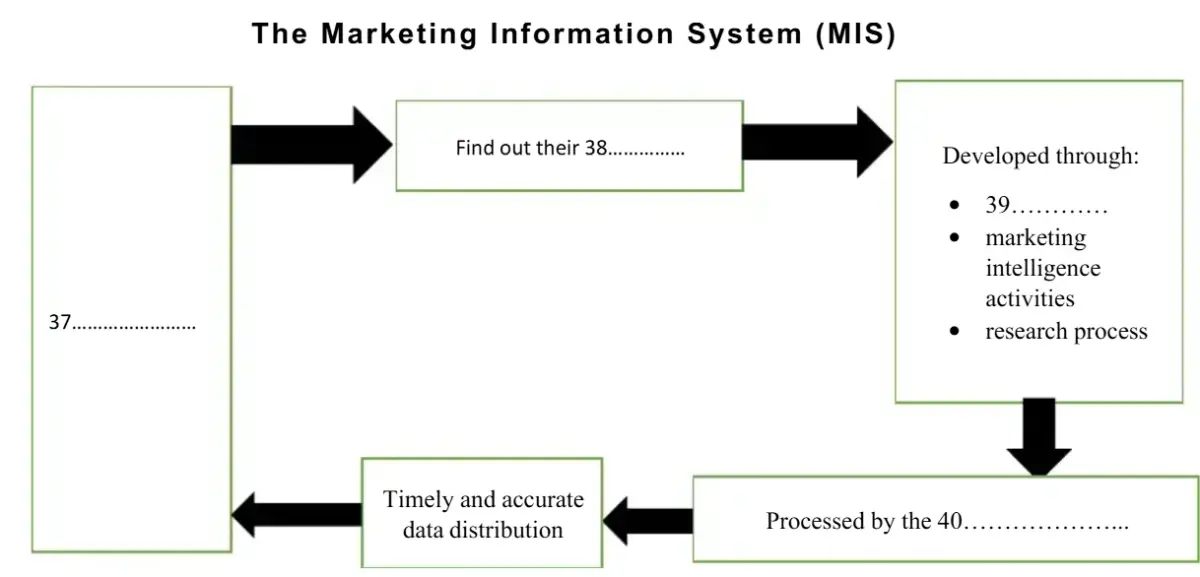
One solution is to use a Marketing Information System (MIS). This consists of people, equipment, and procedures which, when put together, are able to gather, analyse, evaluate and distribute needed, timely, and accurate information to marketing decision-makers. The MIS begins and ends with marketing managers. First, it interacts with these managers to assess the information needs they have. Next, it develops the needed information from internal records, marketing intelligence activities, and the research process. The analysis unit processes the data to make it more useful and, finally, the MIS distributes it to managers in the right form and at the right time to help them make better marketing decisions.
However, the costs of obtaining, processing, storing, and delivering information can mount quickly. In some cases, additional information will do little to change or improve a manager's decision, or the costs of the information will exceed the returns from the improved decision. For example, if an organisation estimates that launching a new product without any further information will yield a profit of $500,000, then it would be foolish to spend $30,000 for additional information that would increase the profit to only $525,000. By itself, information is valueless—its value comes from its use.
Questions 27-31
Which paragraph contains the following information?
Write the correct letter, A-H, in boxes 27-31 on your answer sheet.
The fact that there may be too much information to cope with
The relevance of generating repeat business
An example of personalised marketing
An illustration of a situation where commissioning new might not be advisable
How the greater wealth of customers enables them to select from a broader range of products
Questions 32-36
Do the following statements agree with the claims of the writer in Reading Passage?
In boxes 32-36 on your answer sheet, write:
YES if the statement agrees with the claims of the writer
NO if the statement contradicts the claims of the writer
NOT GIVEN if it is impossible to say what the writer thinks about this
The majority of marketing statistics are gathered by government agencies.
The move from an industrial to an information-based economy has happened more quickly in New Zealand than in Australia.
Employees sometimes hide information that gives a poor impression of them.
Managers frequently fail to make good use of the information they receive.
Marketing information has to be used to be valuable.
Questions 37-40
Complete the Bow-chart below
Choose NO MORE THAN TWO WORDS from the passage for each answer.
White your answers in boxes 37-40 on your answer sheet.
>>> XEM THÊM:
Bảng đáp án đề IELTS READING ngày 13.01.2026 PASSAGE 3
|
27. F |
34. Yes |
|
28. A |
35. Yes |
|
29. B |
36. yes |
|
30. H |
37. marketing managers |
|
31. D |
38. information needs |
|
32. No |
39. internal records |
|
33. Not given |
40. analysis unit |
Bạn có thể xem lời giải chi tiết tại đây: Giải đề IELTS Reading: Marketing and the information age [Full answers]
Khi luyện đề IELTS Reading ngày 13.01.2026 nhiều học viên thường gặp khó khăn trong việc xác định dạng câu hỏi và áp dụng từ vựng học thuật một cách chính xác. Để đạt hiệu quả cao, cần có một kế hoạch ôn tập logic, kết hợp với chiến lược làm bài rõ ràng và sự hỗ trợ từ giáo viên nhiều kinh nghiệm. Để đáp ứng nhu cầu, Langmaster xây dựng các khóa học IELTS online với lộ trình cá nhân hóa. Học viên sẽ được giảng viên theo sát, chỉ ra lỗi sai ngay lập tức trong vòng 24 giờ và hướng dẫn phương pháp học tập tối ưu để tiến bộ nhanh chóng hơn.

Tại Langmaster học viên được:
Coaching 1 - 1 với chuyên gia: Học viên được kèm riêng để khắc phục điểm yếu, phân bổ thời gian thi chi tiết, tập trung rèn kỹ năng chưa vững và rút ngắn lộ trình nâng band.
Sĩ số lớp nhỏ, 7 - 10 học viên: Giáo viên theo sát từng bạn, nhiều cơ hội trao đổi và nhận phản hồi chi tiết.
Hệ sinh thái học tập toàn diện: Tài liệu chuẩn, bài tập online, cộng đồng học viên và cố vấn luôn đồng hành.
Lộ trình học cá nhân hóa: Thiết kế dựa trên trình độ đầu vào và mục tiêu điểm số, kèm báo cáo tiến bộ hàng tháng.
Giáo viên 7.5+ IELTS: Chấm chữa bài trong 24 giờ, giúp bạn cải thiện nhanh chóng và rõ rệt.
Thi thử định kỳ: Mô phỏng áp lực thi thật, phân tích điểm mạnh - yếu để điều chỉnh chiến lược học.
Cam kết đầu ra, học lại miễn phí: Đảm bảo kết quả, giảm thiểu rủi ro “học xong vẫn chưa đạt mục tiêu”.
Học online tiện lợi, chất lượng như offline: Có bản ghi để xem lại, linh hoạt, tiết kiệm thời gian, chi phí.
Đăng ký học thử IELTS Online miễn phí ngay hôm nay để trải nghiệm lớp IELTS tốt nhất cho người mới bắt đầu và nhận lộ trình học tập hiệu quả, giúp bạn thành thạo kỹ năng IELTS!
Khi luyện tập với đề IELTS Reading ngày 13.01.2026, học viên không chỉ xác định được đáp án chính xác mà còn rèn luyện tư duy phân tích theo từng dạng bài một cách hệ thống và chặt chẽ. Việc tiếp cận từ vựng học thuật trong ngữ cảnh thực tế giúp ghi nhớ sâu hơn, đồng thời nâng cao vốn từ quan trọng cho kỹ năng đọc học thuật. Chúc bạn ôn tập hiệu quả và đạt kết quả thật cao trong kỳ thi sắp tới.




Các dạng bài phổ biến và tiêu chí chấm điểm IELTS Reading chi tiết nhất: Multiple Choice, Matching Information, Matching Headings,... và hướng dẫn chiến lược làm bài hiệu quả
Những sai lầm khi luyện IELTS Reading bao gồm: dịch từng từ, đọc hết cả bài, không đọc câu hỏi trước, không quản lý thời gian, không nắm vững kỹ năng paraphrase, viết sai chính tả
![Giải đề IELTS Reading: A brief history of humans and food [full answers]](https://langmaster.edu.vn/storage/images/2025/09/20/a-brief-history-of-humans-and-food-ielts-reading-answers.webp)
Giải đề thi IELTS Reading “A brief history of humans and food” kèm full đề thi thật, câu hỏi, đáp án, giải thích chi tiết, và từ vựng cần lưu ý khi làm bài.

Tổng hợp IELTS Reading tips hay nhất giúp bạn đọc nhanh, nắm ý chính và xử lý thông tin chính xác, tự tin đạt điểm cao trong kỳ thi IELTS.
![Giải đề IELTS Reading: The importance of law [Full answers]](https://langmaster.edu.vn/storage/images/2025/09/22/55.webp)
Giải đề IELTS Reading “The importance of law” kèm đáp án chi tiết, từ vựng quan trọng và bí quyết luyện thi hiệu quả để nâng cao band điểm.




Hơn 16 năm kinh nghiệm, đào tạo thành công 800.000+ học viên
Phương pháp giảng dạy hiện đại, học viên tiến bộ rõ rệt
Lộ trình học chuẩn quốc tế, phù hợp với nhu cầu thực tiễn
Giáo viên đạt chuẩn Quốc tế với chất lượng top đầu thị trường, giàu kinh nghiệm
Học online linh hoạt, cam kết đầu ra bằng văn bản

![Giải đề thi thật IELTS Reading ngày 04.01.2026 [Full Answers]](https://langmaster.edu.vn/storage/uploads/original/2026/02/22/ielts-reading-04-01-2026.png)

![Giải đề thi thật IELTS Reading ngày 16.01.2026 [Full Answers]](https://langmaster.edu.vn/storage/uploads/original/2026/02/24/ielts-reading-16-01-2026.png)